
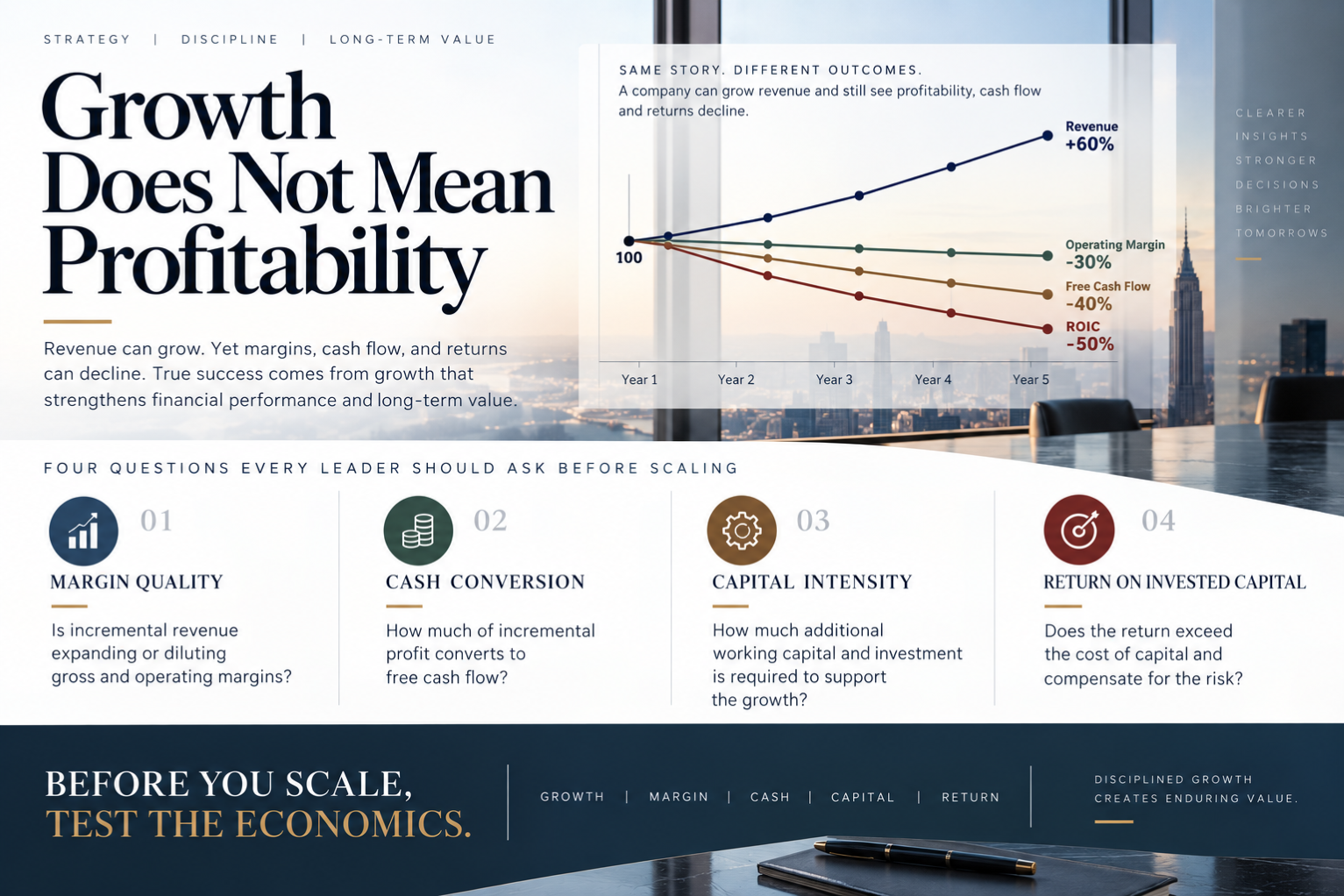
Growth is not the same as value creation.
Revenue can rise while margins compress.
Profit can increase while cash conversion deteriorates.
A business can become larger while simultaneously becoming more capital intensive, more leveraged, and less resilient.
That distinction matters.
For leadership teams evaluating expansion, new markets, acquisitions, pricing strategies, hiring plans, or major capital investments, the question should not simply be: How fast can we grow?
It should be: What are the economics of that growth?
Four areas deserve particular attention.
- Margin quality
Is incremental revenue strengthening gross and operating margins, or diluting them?
- Cash conversion
How effectively does incremental profit translate into free cash flow?
- Capital intensity
How much additional working capital, infrastructure, technology, or financing is required to support the next stage of growth?
-Return on invested capital
Does the expected return justify the capital committed and the risk assumed?
These measures are interconnected.
Growth that requires disproportionate capital, weakens cash conversion, or produces returns below the economic cost of that capital can increase scale without increasing enterprise value.
By contrast, disciplined growth can strengthen margins, generate cash, improve resilience, and expand strategic optionality.
That is why the most important growth conversations are rarely about revenue alone.
They are about the relationship between:
Growth. Margin. Cash. Capital. Return.
Before you scale, test the economics.